Why we built
AEIOU.
The map we wished had existed, written down by the two people who first had to draw it. And the training that grew from the page.
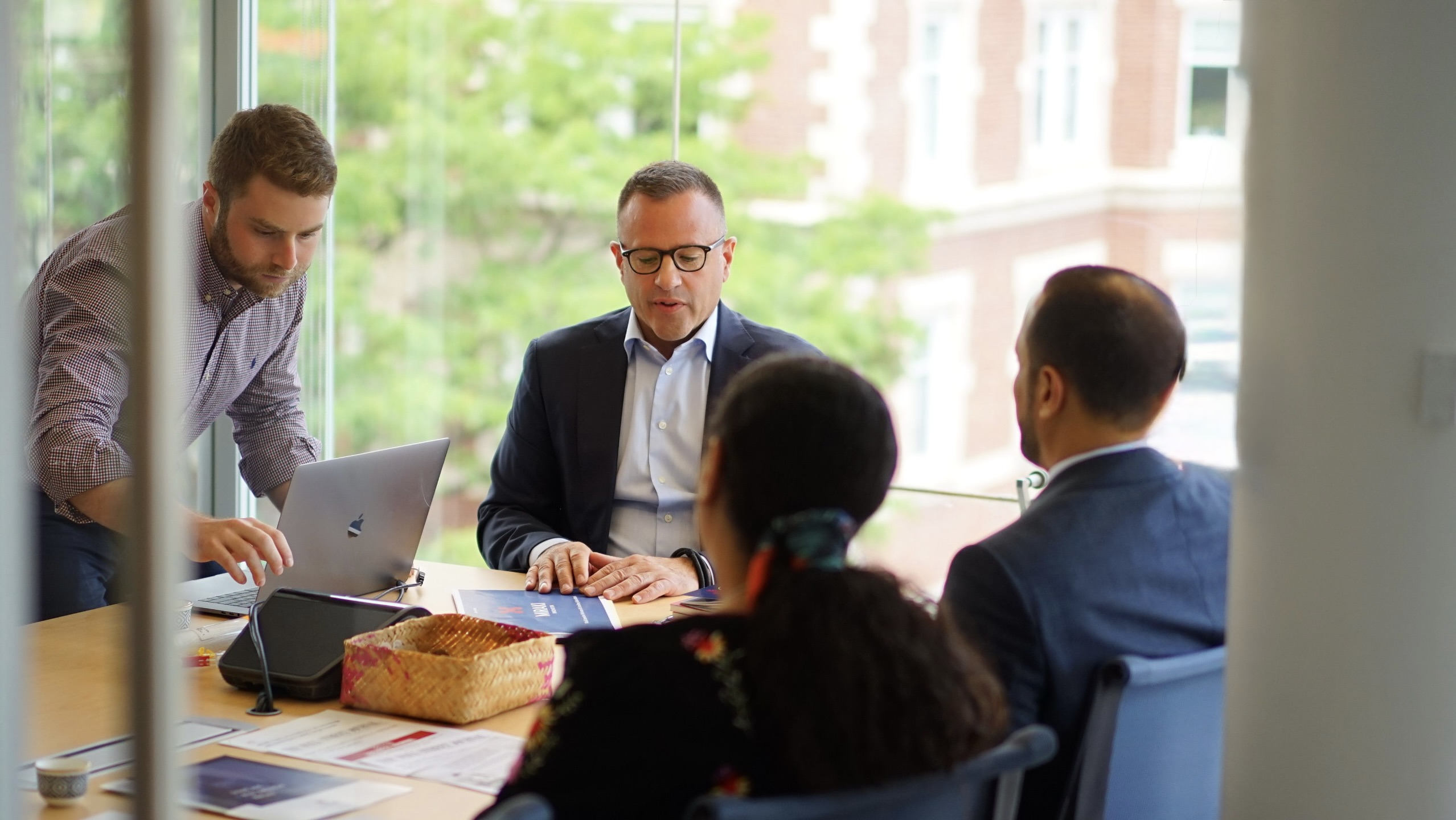
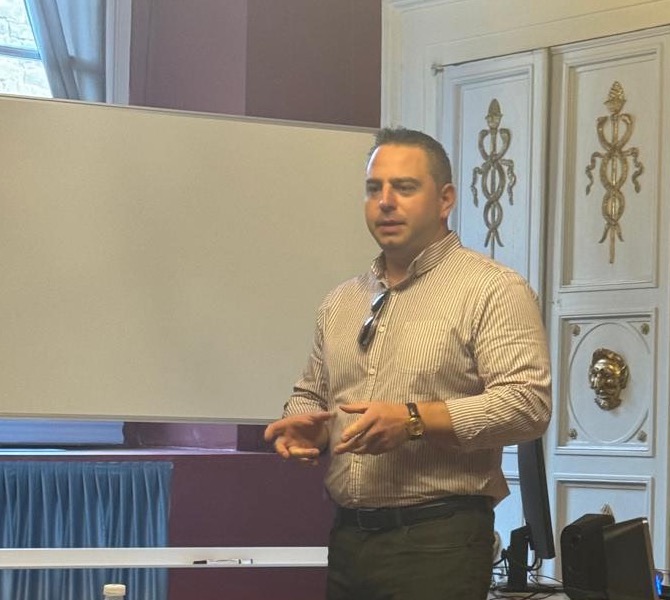
It started in a class at Cornell University, in an executive real estate development program.
Christos was teaching. Chris was a student. Real estate is not the reason they built AEIOU. It was the reason the conversation started.
Chris had a specific reason for being in that room. A career spent on every side of the entrepreneurial process — as an investment banker to medtech and biotech companies, as a private equity operator, as a venture fund founder, and as a company founder who had started and exited businesses — had led to a deliberate pause. He was taking the Cornell program and the NACD Directorship Certification program together, thinking about what came next. Big board seats were available. Real estate was interesting. Neither was the answer.
What became clear was simple. Chris is an entrepreneur and a healthcare entrepreneur. That is not a role he chose. It is in his DNA. What he had found most rewarding across his career was not the deals. It was the teaching, the mentoring, the stewardship of organizational knowledge, and watching teams succeed and ideas come to life. The next chapter was not another board seat or another fund. It was building the training he wished had existed when he started.
Real estate development is an entrepreneurial process. It takes an idea, applies capital, manages risk, and produces an outcome. Unlike the kind of entrepreneurship most founders experience, real estate has something close to a map. There are defined stages. There are mile markers. There are controls at each step. A developer knows what happens between acquisition and entitlement, between entitlement and construction, between construction and lease-up or sale. The vocabulary is standardized. The failure modes are known. The discipline is taught.
Most founders have never sat on a board, much less built one. Most have never raised venture capital, much less negotiated a term sheet. Most have never been through an exit. Most have never navigated the FDA. Most have never structured or run a clinical study. Most have never been in litigation. Most do not understand what their IP is worth, or how to use patents as strategic instruments.
There is a reason real estate has a map and entrepreneurship does not. Buildings are remarkably similar to each other. The differences between one mid-rise and another are real but bounded. The core process repeats. Architects, developers, and general contractors run that process dozens of times across a career, and the lessons accumulate into a discipline that can be written down, taught, and inspected. Tech startups are not like that. Medtech and biotech startups are even less like that. Each one is a different molecule or device, a different regulatory pathway, a different reimbursement environment, a different clinical endpoint, a different competitive set. And most founders run the process once. That uniqueness is why no defined map exists.
Consider what that absence costs. Harvard Business Review reports that eight out of every ten venture-funded companies fail to return capital. In healthcare, the number runs higher. If eight of every ten new buildings fell, or sat unoccupied, or ran out of money before the roof went on, no one would call it entrepreneurship. They would call it a crisis. And they would ask what was missing from the training of the people building them. Is it possible that one of the reasons real estate succeeds more often is that the map is clear? We think so.
But Chris had seen the process from every angle. As an investment banker covering medtech and biotech, as a private equity and venture investor, and as a founder himself — including co-founding Auris Health, which was acquired by Johnson & Johnson for $5.75 billion — he had been across the table, on the board, or in the lead chair on well over a hundred deals. After that many repetitions, the structural pattern had become clear. Beneath the surface variation, the same decisions recur in the same sequence, and the same structural failures recur at the same points. The map was there; it is just that most health entrepreneurs, unlike real estate developers, had not navigated the path enough times to identify and label it. The map had simply never been drawn.
The insight was simple. If the entrepreneurial process could be mapped the way real estate development has been mapped — with defined stages, mile markers, and the specific decisions that happen at each one — founders would make better decisions. Not because they had more talent. Because they had a map.
Chris brought the concept to Christos in January 2025 with a business plan. Christos read it and pushed back on every assumption before agreeing. His response, once he was satisfied, was direct: “Let’s do this, there is nothing like it.”
The pairing matters. Chris has spent his career on the operating side of the entrepreneurial process, across every stage, repeatedly, in the real world. Christos built his career differently—as a practicing academic, operating as an entrepreneur and investing across industries. He has built his career around closing the gap between theory and practice, where most learning breaks down when it matters most. One saw the patterns through repetition. The other understood why those patterns are so rarely learned in time to change the outcome. Each held a different part of the map. Both are rare. Having both is the point.
The idea began with Chris. What made it real was the work Christos did to build it. Without either, there would be no AEIOU.
They spent the year that followed building the first seven evolutions. We are now building the medical program: sixteen evolutions built for healthcare innovators. The healthcare context adds layers the general program does not cover.
What we are offering is not a class and not a degree. It is a detailed map that exists because we built it from decades of iterative experience, much of it painful, much of it expensive, almost none of it taught anywhere else.
“We met at Cornell.”
“Then came the insight.”
“In general entrepreneurship, and particularly in healthcare, almost none of this exists.”
“This is not a failure of the people. It is a failure of the training available to them.”
“That sentence started AEIOU.”
“We built AEIOU so the next generation of founders does not have to learn this the way we did.”
Try to sound the word without its vowels.
Bone and gristle.
Consonants are struck things: the forged steel of capital, the cooled iron of technology, the welded seam of a product, a deck, an idea. Material. Necessary. Not yet speech.
The vowel is the breath the bellows draw — clarity, ethics, vision, voice, leadership. Structure. The architecture. What the material cannot make for itself.
Five of them.
The whole audible round of it.
We teach the breath. Scaffolding, however tall, is what you take down once the building stands.
If this is the training you wish you’d had, start here.
See the program →